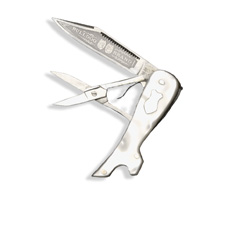
 Pocket Knife patterns are confusing, especially at first, and the only way to learn about them is to spend time handling knives and referring to reference guides. Timber scribers knives, physician knives, veterinary knives, corn knives, smokers knives and Boy Scout knives are just a few of the many examples of pocket knife patterns. The following are many of the Jack Knife patterns: Lockback, Liner-Lock, Trapper, Folding Hunter, Physician, Melon Tester, Peanut, Swell-End, Canoes, Easy-Openers, Fishtail, Sunfish, Electrician, Pruning, Cotton Sampler, Budding, Grafting, Florist, Sailor’s Rope, Rigging, Barlow, Fish, Muskrat, Clasp, Moose, Silver Fruit, Gunstock, Toothpicks. The following are many of the Multi-Blade Knife patterns: Stockman, Utility, Boy Scout, Girl Scout, Horseman, Sportsman, Champagne, Bottle Opener, Smoker, U.S. Military, Cattle, Plier and Wrench (Multi-Tool), Tool Kit, Swiss Army. The following are a few of the Pen Knife patterns: Congress, Whittler, Office, Senator, Sleeveboard, Gunstock, Wharncliffe, Tobacco, Crown, Serpentine, Lobster, Quill, Watch Fob. Then there are: Advertising, Figural, Character and Miniature Knives. The jackknife is reportedly named after Jacque de Liege. He was a French knife maker who is said to have invented the first back-spring assembly. The term is used today to describe many different types of knives. It is most commonly used to describe any knife that has one or two blades that open on the same end. It is also used to describe any knife that has two blades that open in opposite ends and measures more than roughly 3 1/2". You will find that some folding knives do not have any special name and often go only by the generic name "Jack knife". Note that premium jacks are slim, while regular jacks are wider in shape.
As mentioned previously, a "jack knife" is the simplest form of folding knife. The standard jack knife has a blade or blades hinged only on one end; a double-end jack knife is heavier and there is at least one blade that opens on each end. 1. A "pen knife" is a small, light-weight, double-ended knife with two or three blades that are hinged at both ends. A "quill knife," a small pen knife for trimming writing quills, has blades like a tiny jack knife opening only at one end. 2. A "multi-blade pocket knife," commonly called a "Swiss Army knife," has existed for over 100 years and was once referred to as a "sportsman's knife." These knives can have from three to 100 or more blades. 3. Pocket knife styles are influenced by what they are designed to do and are referred to as pruning knives, electrician's and janitor's knives, melon testers, maize knives or cotton samplers, or budding and grafting knives for example. 4. A "whittler" is a very popular and common three-bladed pen knife with two backsprings. The large blade bears on both springs and the two small blades open on the opposite end, each bearing on a single spring. 5. Many multi-blade knives have implements that are not really blades at all, but are screwdrivers, bottle or can openers, pliers or wrenches, cork-screws or leather punches.
Listed below are many of the common (and not so common) Pocket Knife Patterns:
In the Jack Knife category, you will also find the Barehead Jack, Beaver Tail Jack, Crooked Jack, Farmer Jack, Premium Jack, Tear Drop Jack, and the Texas Jack. © 2008 - S.W. Florida Knife Collectors Club
|


