|
Tomahawk tucked in his belt, Spencer Tracy convinces his greatly outnumbered troops that to avoid a hostile Indian camp, they need to take their heavy rowboats out of the water and drag them over a mountain. Playing Robert Rogers in Northwest Passage, Tracy captures the can-do attitude and work ethic that remains a part of the armed forces today.
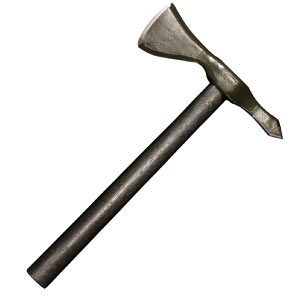
In 1756, Rogers created a military unit named Rogers� Rangers who quickly built a highly successful but unorthodox reputation. They followed a rigid creed and used methods the British considered unconventional. Like today�s military special forces, the men wore camouflage outfits and practiced bold small unit tactics. But those are not the only similarities. Like Rogers� Rangers, modern Special Forces soldiers carry tomahawks. Today, select forces in Afghanistan and Iraq carry tomahawks as a special entry tool because it can quickly open mud-wood structures or break windows to make shooting positions. September�s Blade Magazine carries an interesting article showcasing seven companies that manufacture and supply tomahawks for military use. So why didn�t we know the tomahawk was back in use? According to Justin Gingrich, a military-to-civilian liaison for the Ranger Training Brigade at Fort Benning, Georgia, the last time tomahawks were used was during the Vietnam War. Army Rangers and other special units carried them but were not allowed to bring them home after the war. �The government thought it would be too barbaric or brutal to show the tomahawks,� says Gingrich. Perhaps that is a bit of a disservice to a tool has seen service for over 300 years and gives the user a set of all-in-one choices. It can be used for climbing, digging, chopping, and cutting not to mention its usefulness as a throwing weapon or for hand-to-hand combat. Ryan Johnson�s Eagle Talon appears to go one step farther. Its one piece design gives it the capability of breaking through locks, doors or even cinder blocks and is standard issue for the 1st Batalion, 4th Marine Regiment in Iraq. On his RMJ Forge website, Ryan Johnson details an interesting philosophy that drove him to design his first tactical tomahawk for the armed forces. �I started off making a tactical version. . .forged alloy steel head, Micarta handle�the original design with modern day materials,� said Johnson. �Then I read something that changed my outlook on this type of design forever. At the time I was reading Ayn Rand�s The Fountainhead. Rand has character Howard Roark discussing architecture and design. He noted how people built wooden buildings. Then people made copies of those wooden buildings in stone. Then people made copies of the stone buildings in concrete and steel. They were using the same old designs with new materials. Why not, he suggested, develop new designs that took advantage of the new material properties and technologies?� As a result Johnson created three design laws based on lines and features that worked will in battles past but also integrated new ideas. For example, Johnson�s Eagle Talon is a full tang tomahawk. To break the handle, you have to break the steel. The handle is ovalized and skeletonized to improve grip and the handles can be removed and replaced with simple Philips screw driver. The steel has been parkerized which resists rusting even when scratched because, as Johnson states, �If it was good enough for 6 million M-1�s, it�s good enough for me.� Johnson�s second design law sums it up��Always take past and present battlefield conditions into consideration, and appropriately utilize both old and new materials in the best way possible to meet these conditions.� Following that idea, the Eagle Talon appears to have been earning its place in Afghanistan as an indispensable tool.
� 2005 - Randy (Ransom) Price. Sarasota Florida Knife Collectors Club
Back To The Sarasota FL. Knife Collectors Club Home Page |